Mathematics Empowerment through Standards-Based Grading

Giving students feedback they can act on. Progress they can see. Success they can achieve.

Proven Math Gains

In a study funded by the National Science Foundation, students given opportunities to re-learn and re-assess learned over half a year more math than their peers did. Now, with funding from the Department of Education, we are bringing these proven results to schools—along with ready-made classroom strategies and resources—at no cost.

Bring ME-SBG to Your School: See How It Works

What is Standards-Based Grading (SBG)?

Imagine a 6th grader who scores 70% on a math test. What does that number really tell her—or you? Now imagine instead she gets this feedback: “You understand dividing fractions, but you haven’t yet met standards on using unit rates. Here’s a resource to help; once you practice, we’ll reassess you for full credit.” That’s Standards-Based Grading (SBG). When we tested this approach in classrooms, students learned more than half a year of extra mathematics.
SBG makes grades clearer and more useful:
Academics only — Grades show math learning, not homework completion or behavior.
Recent evidence — Early struggles don’t lock in the grade; the most consistent, up-to-date learning counts.
By standard — Progress is shown skill-by-skill, not hidden inside one average.

Why are we using SBG instead of traditional grading?

SBG helps students learn more effectively by:
Making learning visible — separate ratings for each standard.
Showing the path forward — proficiency maps outline steps from “not yet” to Proficient and beyond.
Recognizing new learning — students can reassess after further study, so early results don’t define the final grade.
Equity through empowerment. Grades focus on academic learning, not behavior, so all students are evaluated fairly on what they know. Clear goals, high expectations, and built-in opportunities for additional learning—followed by reassessment for full credit—give every student a chance to succeed.
Students who learn at different paces, have test anxiety, or face other challenges get multiple ways to demonstrate their knowledge. Students take ownership of their learning and achieve more.SBG makes grades clearer and more useful:
Academics only — Grades show math learning, not homework completion or behavior.
Recent evidence — Early struggles don’t lock in the grade; the most consistent, up-to-date learning counts.
By standard — Progress is shown skill-by-skill, not hidden inside one average.

What People Are Saying

Voices from teachers who have used Standards-Based Grading

Standards Based Grading (SBG) transformed the way my Algebra I classes experienced success in learning. My classes consistently struggled with test anxiety and had a fixed mindset about mathematics. Either they were good at it or they weren’t. SBG allowed me to break instruction and feedback down by specific skills and standards, giving students a clear map of what they knew and where they needed improvement. With targeted feedback, students went from believing they were bad at math to seeing their strengths and having concrete goals for growth. Over time, students improved their knowledge in identified standards and expressed pride in their progress. Their self-confidence soared as they recognized that learning, and grading, was about mastering skills, not just chasing points. Students became more motivated because everyone had a path for success, no matter where they started. This experience cemented my belief that SBG can empower students by making learning clear, attainable, and meaningful.

Jessica Shupik

Math Teacher

As an 8th-grade teacher, I became committed to Standards-Based Grading because of moments like this: A student who struggled with slope turned in a take-home study package—explanations, problems, answer keys—expecting credit. When I explained she needed to show understanding in an assessment, not just complete paperwork, she was upset. Then she asked for the package back so she could actually learn from it. Two days later, she aced the assessment. When my students realized that reassessment meant another chance to actually learn something—not just another chance at points—they learned dramatically more.

Steven Kramer

Project Director, ME-SBG

Upcoming Events List

Event

January 21, 2026

Online

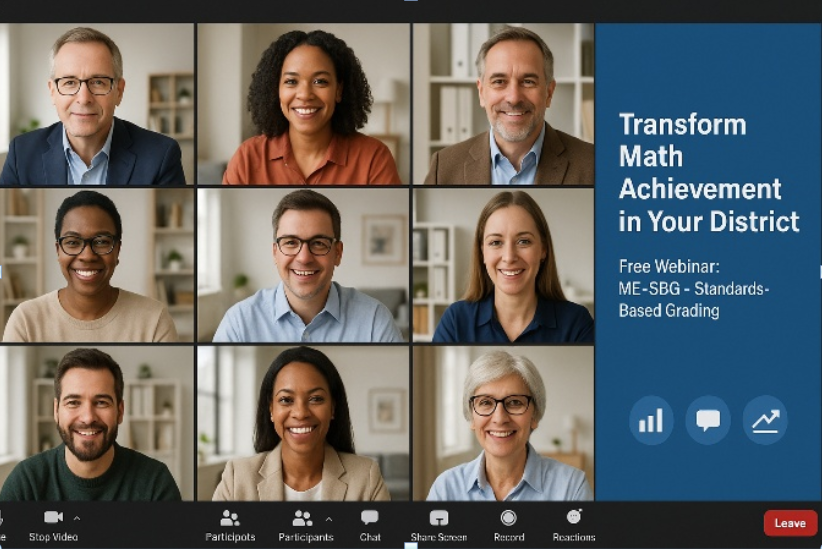
Transform Math Achievement in Your District

Free Webinar: January 21, 2026 | 10:00 AM – 11:00 AM EST
Join our free webinar to learn how ME-SBG delivers 1.5+ years of growth per school year— with full implementation support and paid teacher professional development.
Learn about:

  • Research-proven approach showing dramatic student gains
  • Complete implementation toolkit and ongoing coaching
  • Stipends for teacher PD participation
  • Free curriculum resources and digital tools that stay with you forever


Limited spots for 2026-27 cohort. Application deadline: May 2026
Districts applying by February 27 receive cohort assignment by March.
For: Superintendents, Curriculum Directors, Principals
Co-hosted by Lincoln Intermediate Unit 12 & 21PSTEM

Event

February 10, 2026

Online

Standards-Based Grading: Foundations

Productive Struggle • Depth of Knowledge (DoK) • Formative Assessment • Motivation• Latest Research
Free Professional Development Day February 10, 2026 | Lincoln Intermediate Unit 12 Offices
Learn how Standards-Based Grading (SBG) accelerates math achievement—and discover powerful teaching strategies that work whether or not you adopt SBG.
Morning Sessions:

  • Understanding SBG: Core principles, implementation models, benefits, and real examples—plus Q&A with experienced practitioners
  • Productive Struggle & Growth Mindset: Research-backed strategies to build student achievement

Afternoon Sessions:

  • Depth of Knowledge (DoK): Learn to identify what standards truly ask students to do and how to assess it effectively
  • Choose your track: Formative & summative assessment strategies within SBG OR Building student motivation and productive disposition

Walk away with strategies you can use Monday morning, regardless of your grading approach.
For: Math teachers, instructional coaches, principals, curriculum leaders
Co-hosted by Lincoln Intermediate Unit 12 & 21PSTEM
[Register Interest using Contact Us]

Latest Updates

Stay up to date with news, events, and research from MESBG.

Research

How Standards-Based Grading Builds Confidence

Teachers and students share how clarity in grading leads to higher engagement

Tracey Wilson

August 20, 2025

Blog

How Standards-Based Grading Builds Confidence

Teachers and students share how clarity in grading leads to higher engagement

Tracey Wilson

August 20, 2025

News

How Standards-Based Grading Builds Confidence

Teachers and students share how clarity in grading leads to higher engagement

Tracey Wilson

August 20, 2025

MESBG Partners

Jessica Shupik, Ed.D.

Consultant

Dr. Jessica Shupik’s professional journey has been defined by a passion for designing transformative learning experiences and driving positive organizational change. Through her doctoral research, Dr. Shupik has cultivated expertise that bridges research and real-world application. Throughout her roles in public education, corporate training, and nonprofit consulting, she has consistently developed and implemented initiatives that translate complex goals into measurable improvements in performance and engagement. As a learning professional, Dr. Shupik has crafted solutions tailored to diverse learners, from piloting programs that boosted test scores to leading national conference presentations on tech-infused education. She is recognized for her engaging public speaking, collaborative approach, and the ability to bridge communication across departments to achieve lasting, meaningful results.

Teya Rutherford

Consultant

Dr. Teomara (Teya) Rutherford is an Associate Professor of Learning Sciences in the University of Delaware School of Education. She received her PhD in Learning, Cognition, and Development from University of California, Irvine, her JD from Boston University School of Law, and her bachelor’s degree in Elementary Education with a concentration in Computers in the Classroom from Florida International University. Dr. Rutherford’s research focuses on learning and motivation, especially in STEM and in digital contexts. Currently, she works on a number of federally-funded projects on K-12 mathematics and cybersecurity education and on university computer science. In each, she uses design tools, such as logic models and theories of change, to connect researchers, developers, and practitioners in creating, implementing, and evaluating learning-focused tools and products.

Chris Heckman

Student Success Programs Supervisor for PPS

Chris Heckman is the Student Success Programs Supervisor for Portland Public Schools in Oregon, where he supports work in mathematics standards and assessments. He’s taught 6-12 grades math for twelve years in the Portland area and has loved his experiences in math education working with youth. Apart from work, Chris stays active through exercise, outdoor adventures, and the occasional home repair project, expresses creativity through cooking and music (guitar and piano), and finds inspiration through reading and mindfulness / meditation. Currently, his two favorite teachers are his seven-year-old child – who offers daily lessons in wonder (and patience) – and his incredible wife, who he’s still working hard to impress.

Vivian Loewenstern

Standards-Based Grading Specialist

Vivian Loewenstern-Jaffe has the background and experience that make her ideally qualified to play a supportive role in the Mathematics Empowerment through Standards-Based Grading Program.  After a distinguished career as a mathematics teacher, she was a central office administrator in two school districts where she had the responsibility of implementing standards-based grading district-wide. In addition, she was a lead in the development of the mathematics curriculum and collaborated with others on the mathematics assessment system for a USAID funded project to develop STEM high schools in Egypt. In this role, not only did she create country-wide math assessments, but she performed numerous country-wide presentations on standards-based grading for teachers, administrators, and supervisors.

Kylie Doyle

Logistics Coordinator and Administrative Assistant

Kylie Doyle is a Logistics Coordinator and Administrative Assistant on ME-SBG. She primarily works with travel, event coordination, and a multitude of other administrative duties to support the project. She has a background in visual arts, which she uses while managing the website and creating social media content along with other materials for ME-SBG. After work, Kylie enjoys writing, making art, and maintaining a growing collection of indoor and outdoor plants.

Tim Flood

Lead Software Engineer

Tim Flood is the Lead Software Engineer for ME-SBG. In this role, he architects and develops the web-based platform that enables teachers to implement standards-based grading with their students, designing systems that handle LMS integration, standards management, and student performance tracking. A former project manager and scrum master turned software engineer, Tim collaborates with the ME-SBG team using Agile practices to deliver teacher-friendly tools. Outside of work, Tim’s interests range across weightlifting, long-distance swimming, reading, and drawing.